
My Blog
INTERVIEW EXCLUSIVE: SEAN LANIER HOLMES
January 5, 2025 | Interview Exclusives
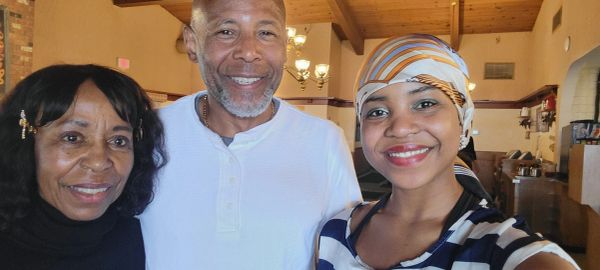
By Taleena LaVerne · 1/5/2025
The interview takes place in an old-fashioned diner. Ms. Wellness and I sit in a far-back booth near the fireplace, its warmth cutting through the chill of the day. We've ordered our drinks—a glass of ice water with lemon and a straw for her, and a cup of Earl Grey tea with plenty of honey for me.
Sean arrives before the drinks.
After a quick exchange of greetings, Ms. Wellness begins one of her stories.
Ms. Wellness: "When I was younger, I jumped into a pool. I didn't know how to swim. I didn't even know to hold my breath. So I passed out."
She pauses.
"When I woke up, my ears were ringing. And they didn't stop—months of constant ringing. It was unbearable. Busby, a family friend—well, more than that, he was a pastor—offered to help. I had been in his home for spiritual gatherings a few times in the past, and when I told him about my constant ringing in my ears, he invited me to a gathering."
At the mention of Busby, Sean perks up, recognition flashing across his face.
"I remember Busby!" Sean says.
Ms. Wellness: "He brought out olive oil. Rubbed it around my head and ears. Then he called everyone into a circle, and we prayed. I don't know if it was during the second or third week, but suddenly, the ringing stopped. Completely gone. It hasn't come back since."
Ms. Wellness: "No surgery. Nothing. I'm a walking testament."
Sean nods, his interest evident. After a moment, he asks about him, their overlapping familiarity with the pastor adding a new layer to the conversation.
Ms. Wellness then recalls the night we saw Sean and Mel Brown at Motown Monday at Ilani Casino, just weeks before this interview.
Ms. Wellness: "We had so much fun!"
(She refers to the lively performance and the unforgettable dancing we shared that night.)
Sean smiles and says: "Folks like you are the reason we make music."
The waiter arrives to take our order. I've made it a habit to order for my particular grandmother: a Dutch baby, half a cup of decaf coffee, extra napkins, whipped cream, and hot syrup. I stick to my usual buttermilk pancakes, while Sean opts for a veggie bowl with hash browns and raspberry hibiscus tea—one of my favorites.
As we settle in, Sean shares his secret to looking so youthful at 58: cutting out gluten, dairy, and red meat. I immediately respond, "Oh my goodness, I could never live like that," which makes us all laugh.
"Well, you don't have to. You're young. But I started noticing dietary issues, so I had to make some changes. It's been worth it—I've dropped thirty pounds. Some people don't even recognize me anymore!"
Sean admits giving up bacon was the hardest part. "I love me some bacon," he says with a laugh. "But they've got so many more options now. Gluten-free bread used to be awful, but it's gotten so much better."
Sean looks vibrant, his energy undeniable—a true reflection of the benefits of self-care.
"How many years have you been in the music industry?"
"Forty years!" Sean responds with a proud smile. "I've been at this a long time. I've been a professional since I was 18. My first studio sessions were with my mother in the Los Angeles area."
He pauses. "Another early recording session I had was at the Jacksons' home. I used to skate with them at a place called Sherman Square Roller Skating Rink in Reseda, California. That's how I met the Jacksons. I was actually the only one in the crew that Janet would ask to couple skate with."
He mentions that their birthdays are just one day apart—his is May 18. I wish him a happy belated birthday.
"When I came to Portland, I came to Concordia College on a basketball scholarship in 1986. That's what brought me here. Before the plane landed, it already felt like home to me. Maybe that was just a young man growing up and trying to settle, but who knows? That's how I felt, and I haven't really left."
"At college, I started studying voice and classical music. My voice teacher put me into recitals where I could earn money. While in college, I sang the national anthem as part of the basketball team—it was a great honor. That night, I met two professional musicians in the audience. We connected and have worked together for years."
"Also, the music director of the college approached me and said, 'If this basketball thing doesn't work out and you want to trade in your hoop shoes for a choir role, I'll match your scholarship.' And that's what happened."
"That was a huge transition in my life. With the basketball team, we'd travel to places like Idaho and Washington to play other teams. But with the choir, I got to travel to Japan, Hong Kong, Hawaii, Florida, and all over Oregon."
"People come into your life for a reason," says Ms. Wellness. "What kind of music do you prefer to play?" she asks.
"Yes, I've never had an agent. I play lots of styles, which is one of the things that's kept me working. I sing R&B, jazz, soul, funk, blues, and even classical."
Ms. Wellness: "We were getting down with Stevie Wonder."
She recalls the incredible show where Sean performed music by Stevie Wonder, Otis Redding, and a stunning rendition of "What's Going On" by Marvin Gaye.
"Thank you!" Sean responds warmly. "Stevie is one of my idols. As a kid, I didn't read a lot of books, but looking back, albums were my books. You'd always find me sitting at a stereo, reading all the album covers front to back. I knew every musician. I got to a point where I could hear a song and say, 'That's Marcus Miller!' just from studying those albums."
Ms. Wellness: "So, speaking of albums, do you have any of your own?"
Sean nods. "Yes, I've released music and was recently featured on Chance Hayden's Baritone Gold album. I sang a track called 'Bank On Me.'"
"Growing up in a family of musicians, did you ever feel pressured to pursue a career in music?"
Almost immediately, Sean responds. "No. It was very natural. I never felt any pressure. I always joke and say I had no choice," he adds with a laugh.
"But in a good way," he continues, smiling as he reflects on his childhood. "My family isn't just filled with musicians; it's also filled with music fans. They were always encouraging—always showing up at everything. My grandparents even had me sing a song before I went to bed at night."
"In some ways, I was so confident that I passed on some opportunities that other people would slap me for not taking now. Like when I hung out with the Jacksons, I sang a demo for them in their house studio. That's the same studio that Michael recorded Off the Wall for his vocal track, and that was such an honor to be in that room. So then Janet offered me the chance to go to Minneapolis with her to record the Control album. I said, 'Oh no. I'm going to college.' And so I went to college instead of recording the Control album with Janet Jackson, which is probably her highest-selling album to this day."
"How did your interactions with local Portland musicians influence your musical style and identity?"
"I'm still being influenced. I've been so blessed to just meet the next person. I've seen so many of the great singers that have come and gone—Linda Horn, Veranda Steele, Shirley Dunnett, and her daughter!"
"You have performed at many high-profile festivals and events; how do you mentally and emotionally prepare for those?"
"Well, we have to rehearse, whether that's on my own or together. Sometimes on these shows, when you're playing with other world-class musicians, they don't necessarily want to rehearse. They may feel like that might take time away and money away that they're making for the gig. So if you're good enough, you just get the information and rehearse yourself, but it's still important to do that because if you show up and don't know your stuff, then you'll be nervous."
"They even had a masseuse at the Blues Festival stage that I went to sometimes to get a little relief! My choir director used to split up the word for us to understand—'re-HEAR-sal.' Sometimes you really have to get it in your ear to understand the music you're playing."
"As a young person, I was impatient and wanted to play piano like Thelonious Monk. But we all have to go through the steps. I would also say to appreciate the journey and know that it is one. There are no quick fixes to being a great musician. You can try to have instant fame. But that doesn't make you a great musician."
"Some people get confused with being a professional musician versus being famous; I don't confuse the two. And that's part of the reason why I left Los Angeles—because I don't care about fame. For me, it truly is about the music and the art form, collaboration with other musicians, and creating and connecting with the audience."
Sean's story is a powerful reminder that success is about authenticity and passion. From the Jacksons' studio to Portland's vibrant music scene, his journey has been about embracing the art, not the spotlight. As he continues to inspire audiences, Sean's dedication to his craft serves as an example for aspiring musicians everywhere.